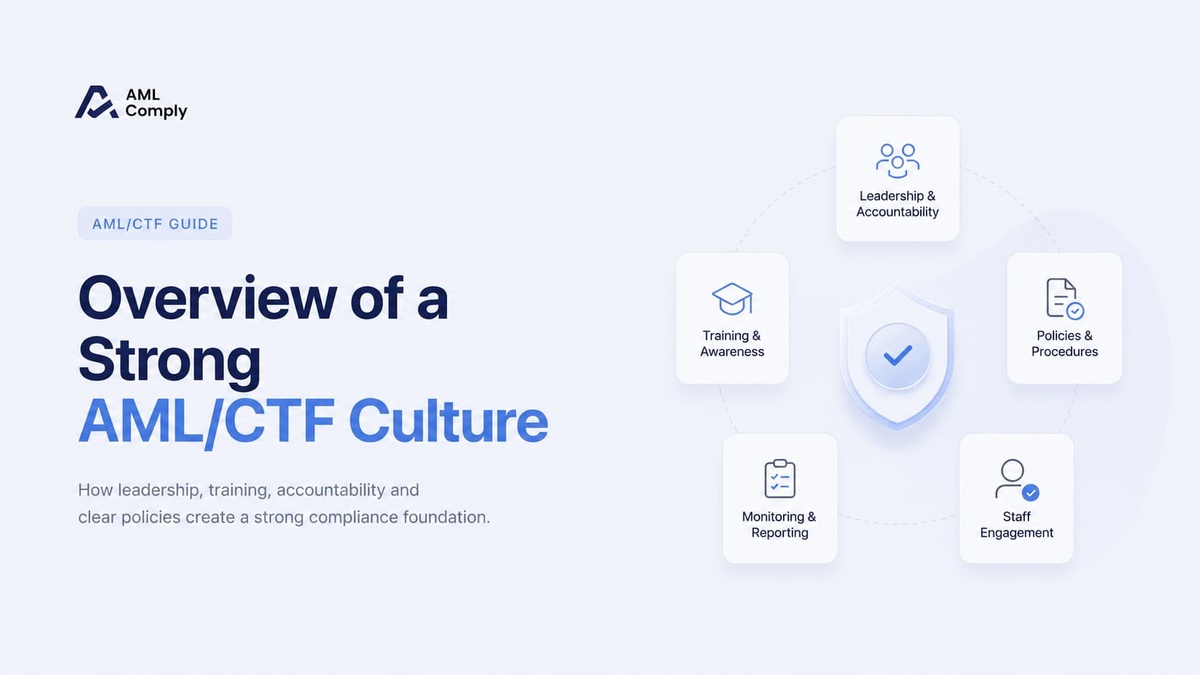
AML Comply has provided a summary of AUSTRAC’s guidance relating to a Strong AML/CTF Culture below. Please note that this overview is intended as a guide only; for comprehensive details, the full AUSTRAC documentation is included further down this page.
Summary
A strong AML/CTF culture reflects how a business values and prioritises anti-money laundering and counter-terrorism financing (AML/CTF) compliance, underpinned by effective oversight from the governing body. While not a legal requirement, a strong culture is a key indicator that a business is taking reasonable steps to meet its AML/CTF obligations.
Key Features of a Strong AML/CTF Culture:
- Proactive Risk Management: The business understands ML/TF risks and continuously updates its risk awareness.
- Independent Assessment: High-risk relationships are evaluated independently of business interests.
- Training and Awareness: Regular AML/CTF training is provided to staff, senior management, and the governing body.
- Decision-Making: ML/TF risks are considered in key decisions to avoid unacceptable exposures.
- Accountability and Incentives: Staff are disciplined for non-compliance and rewarded for positive AML/CTF behaviour.
- Compliance Officer Role: The AML/CTF compliance officer is independent, knowledgeable, well-resourced, and empowered to challenge business priorities that create ML/TF risks.
- Governing Body Engagement: Sets the tone from the top, takes AML/CTF seriously, engages with compliance reports, and ensures senior management prioritises risk mitigation.
- Reporting Mechanisms: Staff can confidentially raise compliance concerns, and issues are addressed promptly in collaboration with the compliance officer.
Indicators of Poor AML/CTF Culture:
- Lack of governing body engagement with AML/CTF risks and compliance.
- Treating AML/CTF solely as a legal obligation, rather than a business priority.
- Appointing a compliance officer without credibility, authority, or resources.
- Ignoring compliance reports or failing to integrate ML/TF risk into key decisions.
- Failing to promote AML/CTF processes, procedures, or training.
A strong AML/CTF culture ensures the business actively manages ML/TF risks and demonstrates a commitment to compliance across all levels of the organisation.
Overview of a strong AML/CTF culture
Author: AUSTRAC
This section refers to the Act section 26H(1).
A strong AML/CTF culture reflects how a business values and prioritises AML/CTF. This links to the governing body, which must appropriately oversee and reasonably manage the business’s AML/CTF compliance and ML/TF risk framework.
Creating a strong AML/CTF culture
A strong AML/CTF culture is achieved by your governing body, senior managers and AML/CTF compliance officer working together to make sure your AML/CTF obligations are met.
A strong AML/CTF culture isn’t a legal requirement but is often a reliable driver and indicator that your business is taking reasonable steps to meet its obligations. We’ll look for evidence of such a culture in our supervision.
Indicators of a strong AML/CTF culture
A business with a strong AML/CTF culture:
- understands their ML/TF risks and continues to proactively update their understanding in response to changing circumstances
- assesses high ML/TF risk relationships independently, not based solely on business interests
- provides regular AML/CTF training to staff, senior management and the governing board
- considers ML/TF risk when making key decisions and avoids creating unacceptable risks
- has disciplinary measures for staff that don’t follow AML/CTF procedures
- rewards positive compliance behaviour in the business.
The business also:
- has an AML/CTF compliance officer that’s independent from external and internal influences and challenges business priorities that create ML/TF risk
- has an AML/CTF compliance officer that’s knowledgeable and well-resourced
- has a governing body that sets the tone from the top and takes ML/TF risk mitigation and AML/CTF compliance seriously
- has a governing body that engages meaningfully with reports from the AML/CTF compliance officer
- makes sure that senior managers take ML/TF risk mitigation and AML/CTF compliance seriously and prioritise this in their management decisions
- has a governing body that receives regular AML/CTF updates from the AML/CTF compliance officer, including concerns about compliance
- promotes AML/CTF processes and procedures, and trains staff on compliance obligations and ML/TF risks
- has a governing body that works with the AML/CTF compliance officer to promptly address compliance concerns
- has a mechanism for staff to confidentially raise compliance concerns.
Indicators of a poor AML/CTF culture
A business with poor AML/CTF culture:
- has a governing body that isn’t engaged with AML/CTF risk management and compliance, and doesn’t receive updates on ML/TF risk and compliance
- views AML/CTF compliance as a legal obligation only, rather than a business priority
- appoints an AML/CTF compliance officer who lacks credibility, experience or authority
- ignores reports and recommendations from the AML/CTF compliance officer
- fails to consider ML/TF risk in key business decisions
- doesn’t promote AML/CTF processes, procedures and training for staff
- doesn’t engage with the AML/CTF compliance officer to resolve concerns.
14 March 2026